.png?width=1780&height=469&name=_New%20Logo%20INSUREU2%20AI%20(11).png)
The Hidden Revenue Gap: When Agents Identify Opportunities… But Don’t Act
You’re Not Losing Opportunities Because Agents Miss Them
You’re Losing Them Because They Don’t Act on Them
If you ask most agency owners where revenue is being lost, the answer is usually the same:
- “Agents aren’t identifying opportunities”
- “They’re not asking the right questions”
- “They need more training”
But after analyzing real call data, a different problem becomes clear:
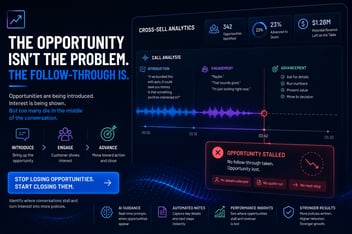
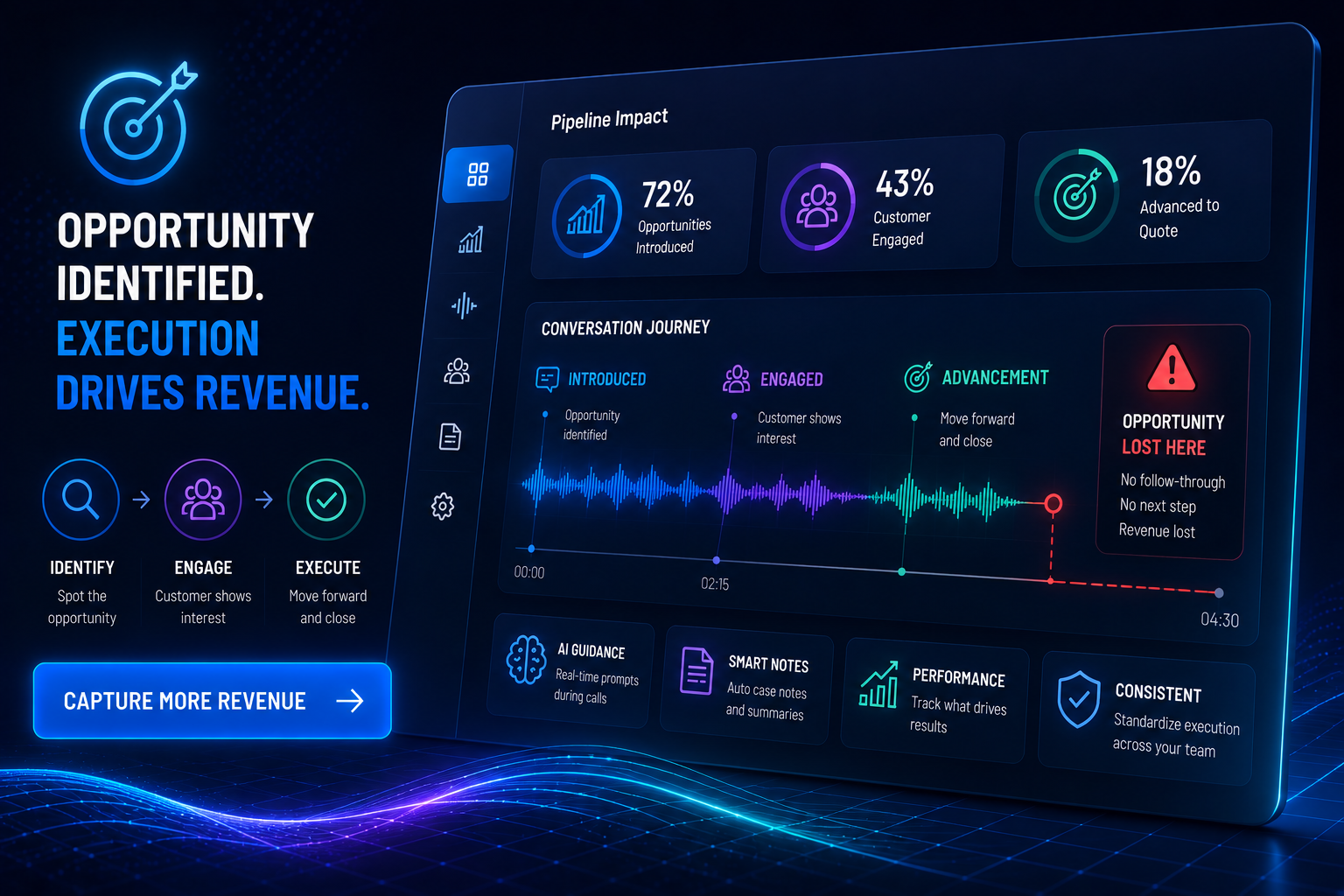
The opportunity is often identified… but nothing happens next.
And that gap is where revenue quietly disappears.
What Actually Happens on Real Calls
Let’s walk through a real scenario.
An agent is on a call with a prospect shopping for homeowners insurance.
They ask the right question:
“Who is your auto currently insured with?”
This is the exact moment where a multi-policy opportunity is created.
The customer is open. The door is open. The opportunity is real.
But instead of moving forward, the conversation shifts.
- No quote is offered
- No follow-up questions are asked
- No bundling recommendation is clearly positioned
The agent acknowledges the opportunity… then moves on.
The result:
No additional policy. No increased revenue. No improved client value.
This isn’t a rare mistake.
It’s happening across agencies, every single day.
The 3 Levels of Opportunity Execution
From reviewing real conversations, agent behavior typically falls into one of three categories:
Level 1: Identification Only
The agent asks:
- “Do you have auto insurance?”
But stops there.
No recommendation. No action. No progression.
Outcome:
Opportunity is visible… but lost.
Level 2: Partial Action
The agent:
- Mentions bundling
- Talks about savings
- Brings up the idea
But doesn’t take control of the next step.
They don’t:
- Gather full details
- Run a quote
- Move toward closing
Outcome:
The opportunity is introduced… but never converts.
Level 3: Full Execution
The agent:
- Identifies the opportunity
- Clearly explains the value
- Collects the required information
- Commits to a next step (quote, comparison, follow-up)
Outcome:
Opportunity becomes real pipeline.
Most agencies believe their team is operating at Level 3.
In reality, many agents are stuck between Level 1 and Level 2.
And that difference is costing more than most realize.
Why This Happens (Even With Good Agents)
This isn’t a motivation issue.
It’s not even a skill issue.
It’s an execution-in-the-moment issue.
During a live call, agents are:
- Thinking about the current quote
- Trying to build rapport
- Navigating objections
- Remembering processes
- Managing time
Even well-trained agents forget, hesitate, or move on too quickly.
That’s why one of the most common problems agents report is:
- Not knowing exactly what to say during live calls
- Missing cross-sell opportunities
- Forgetting key talking points in the moment
Training teaches what to do.
But calls require real-time execution.
The Cost of “Almost”
Here’s the dangerous part:
These aren’t obvious failures.
They’re “almost” moments.
- The agent almost closed the bundle
- They almost asked the follow-up
- They almost moved forward
But “almost” doesn’t generate revenue.
When this happens across:
- 10 agents
- 20 calls per day
- 30 days per month
The lost revenue compounds fast.
And because the opportunity was technically identified, it often goes unnoticed.
Why Traditional Solutions Don’t Fix This
Most agencies try to solve this with:
More Training
But training happens before the call.
The breakdown happens during the call.
More Coaching
Managers can’t realistically sit on every call.
And post-call feedback is too late.
Better Scripts
Scripts rely on memory.
Calls are unpredictable.
These approaches improve awareness.
But they don’t fix execution in the moment.
What Actually Fixes the Gap
To close this revenue gap, agents don’t need more information.
They need guidance at the exact moment the opportunity appears.
That means:
- Knowing what to say
- Knowing how to position it
- Knowing how to move forward
While the conversation is still happening.
This is where real-time guidance changes everything.
Instead of relying on memory, the agent is prompted:
- When to introduce bundling
- How to explain the value
- What question to ask next
- How to move toward a quote
Not after the call.
During it.
The Shift: From Awareness to Execution
The difference is simple:
Before:
- Agents identify opportunities inconsistently
- Execution varies by experience
- Revenue depends on individual performance
After:
- Opportunities are surfaced automatically
- Conversations are guided in real time
- Execution becomes consistent across the team
Instead of hoping agents act…
You ensure they do.
Final Thought
The biggest revenue problem in most agencies isn’t visibility.
It’s execution.
Your agents are already having the right conversations.
The opportunity is already there.
The question is:
Are they acting on it when it matters most?
If You Want to See This in Action
If you’re serious about understanding what’s happening inside your calls:
-
See exactly where opportunities are being identified… and where they’re being missed.
-
Watch how real-time guidance changes the outcome of a live conversation.
-
And see what’s possible when every agent executes like your top producer.